Invisible Vapor
Mercury vapor cannot be reliably evaluated by sight or odor. Instrument measurements or laboratory air samples are needed.
Certified Industrial Hygiene and Indoor Environmental Testing
Independent mercury vapor air sampling, spill assessment, post-cleanup verification, occupational exposure evaluation, laboratory analysis, and written reporting for homes, apartments, schools, offices, health care facilities, laboratories, and commercial buildings.
Independent mercury assessment
Angstrom Testing Services LLC provides independent mercury vapor testing, air sampling, direct-reading evaluation when included in the project scope, laboratory coordination, result interpretation, and written reporting for residential, commercial, institutional, and occupational settings.
Mercury testing may be requested after a thermometer, thermostat, manometer, barometer, blood-pressure device, laboratory instrument, fluorescent lamp, electrical component, or other mercury-containing product breaks or leaks. Testing may also be used when a past spill is suspected, cleanup was incomplete, mercury was vacuumed, or documentation is needed before an area is reoccupied.
We provide testing, inspection, sampling, consulting, and reporting. We do not perform mercury cleanup, hazardous-waste removal, restoration, or remediation contracting. This separation helps keep the assessment focused on site conditions, sample locations, analytical results, project objectives, and appropriate next steps.
Understanding the concern
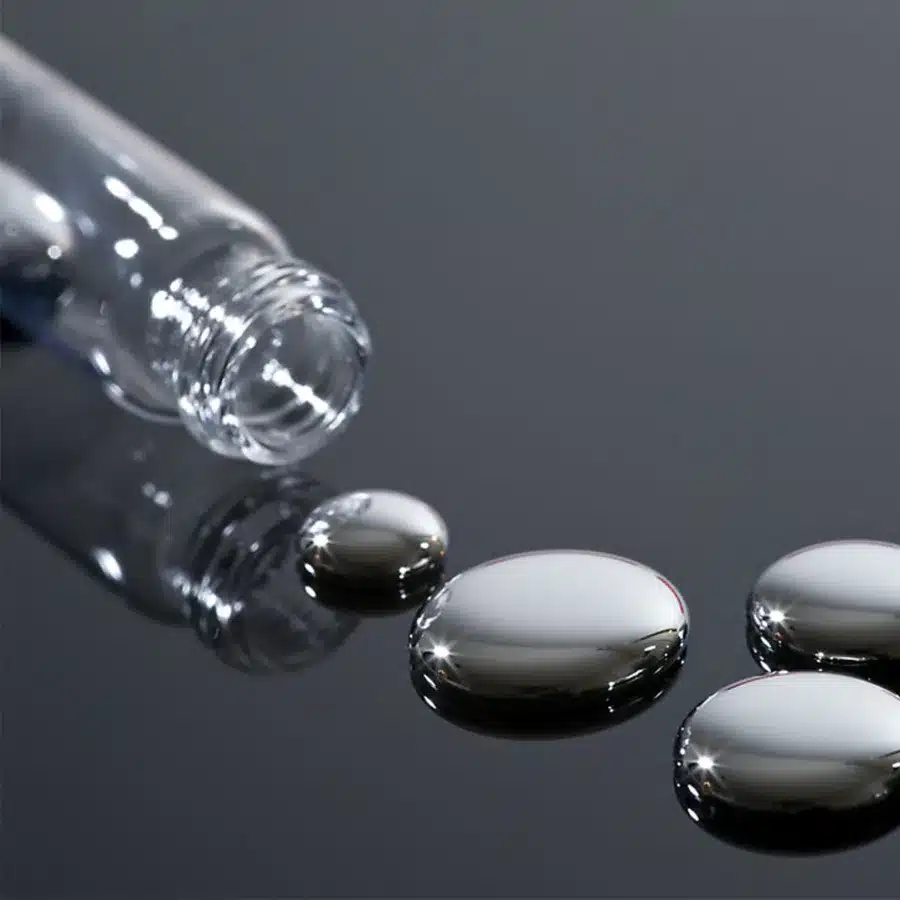
Elemental mercury is a silver-colored liquid metal. When mercury is spilled indoors, small droplets can separate, roll away from the visible spill, lodge in cracks and porous materials, and continue releasing vapor into the air. Mercury vapor is not visible and does not have a warning odor.
The concentration present during testing can be affected by the amount and location of residual mercury, room temperature, ventilation, air movement, surface type, cleanup methods, building operation, and the time that has passed since the spill. A complete assessment may therefore require a combination of spill-history review, inspection, source-area evaluation, air sampling, and targeted follow-up testing.
Mercury vapor cannot be reliably evaluated by sight or odor. Instrument measurements or laboratory air samples are needed.
Small droplets may move beneath baseboards, into floor seams, under equipment, or into carpeting and furnishings.
Indoor temperature, sunlight, heating systems, and ventilation conditions can influence the vapor concentration measured.
Sampling locations, duration, analytical sensitivity, and comparison criteria should be selected for the specific building and testing objective.
When testing may be useful
Available project scopes
Time-integrated air samples may be collected on Hopcalite sorbent tubes using calibrated sampling pumps and submitted for laboratory analysis.
A mercury vapor analyzer may be used when included in the scope to screen rooms, locate potential source areas, evaluate pathways, or guide additional sampling.
Samples may be placed in the spill room, occupied areas, nearby rooms, corridors, HVAC zones, or a comparison location depending on the investigation.
Testing may help document selected air conditions after professional spill cleanup, removal of contaminated materials, ventilation, or other corrective work.
Personal breathing-zone and area sampling may be considered for laboratories, facilities, maintenance operations, manufacturing, and other workplace settings.
Documentation may include observations, sampling methods, locations, conditions, laboratory results, interpretation, limitations, and recommended next steps.
Preferred sampling method
We review the spill history, product involved, estimated amount, cleanup actions, building use, affected rooms, occupancy concerns, and documentation needs.
Locations are selected to address the suspected source area, occupied breathing zones, possible migration pathways, adjacent spaces, and any appropriate comparison area.
A representative sampler is used during pump calibration. Samples are collected at a known low flow rate for a volume appropriate to the project and laboratory requirements.
The sorbent media are analyzed for elemental mercury using cold-vapor atomic absorption or an equivalent laboratory system consistent with the method.
Results are reviewed with the sample volume, reporting limit, room conditions, spill history, ventilation status, field observations, selected guidance, and project limitations.
Potential indoor sources
Some newer thermometers use alcohol, dyed liquid, or a gallium-based metal alloy instead of mercury. Product labeling, manufacturer information, photographs, and the appearance of the liquid may help identify the material, but uncertain spills should be treated cautiously until the product and conditions are evaluated.
Data interpretation
Mercury vapor results should be interpreted for the specific purpose of the assessment. Occupational exposure limits, public-health spill guidance, residential reoccupancy guidance, laboratory reporting limits, and project-specific screening values do not all serve the same purpose and should not be treated as interchangeable.
Interpretation may consider the analytical result, units, sample duration, total volume, detection limit, location, height, room temperature, ventilation, building operation, spill history, cleanup history, susceptible occupants, direct-reading data, and whether the objective is source identification, exposure characterization, cleanup verification, or reoccupancy support.
Environmental testing evaluates selected building conditions and samples. It does not diagnose illness or determine whether a particular exposure caused a medical condition. Health concerns should be discussed with an appropriate health care professional or public-health agency.
Project documentation
Important limitations
Air sampling represents selected locations and conditions during the sampling period. Concentrations may change with temperature, ventilation, heating or cooling operation, occupant activity, source disturbance, cleanup work, door position, and other building conditions.
A low or non-detect result in one location does not prove that mercury is absent from all rooms, cracks, contents, equipment, or concealed spaces. Post-cleanup testing does not replace an appropriate spill cleanup, visual inspection, waste-disposal process, or source-removal effort.
The number and placement of samples should be based on the spill history and intended use of the results. Additional sampling, direct-reading measurements, professional cleanup, disposal assistance, medical consultation, or agency involvement may be recommended depending on the findings.
Regional coverage
Angstrom Testing Services provides mercury vapor testing and industrial hygiene consulting in New York City, Long Island, Westchester, southern Connecticut, eastern New Jersey, and nearby areas. Service availability depends on the urgency, property type, spill conditions, required equipment, laboratory schedule, and project scope.
Related environmental services
Angstrom resources
Public-health references
The following NYSDOH resources provide public-health information on elemental mercury, spill response, cleanup, measurement, interpretation, and disposal considerations.
Mercury testing FAQs
Mercury vapor testing measures elemental mercury present in air at selected locations and under the conditions present during sampling. A project may include time-integrated laboratory samples, direct-reading measurements, inspection, and written interpretation.
NIOSH 6009 provides a recognized procedure for collecting elemental mercury vapor on a Hopcalite sorbent tube and analyzing the sample by cold-vapor atomic absorption. It is useful when laboratory-supported, time-integrated air results and defensible documentation are needed.
Yes. The sampling plan may include the spill room, nearby occupied areas, adjacent rooms, possible migration pathways, and a comparison location. The appropriate scope depends on the amount spilled, surface type, cleanup actions, elapsed time, ventilation, and occupancy.
Stop using the vacuum, keep it from being moved through occupied areas, restrict access to the affected space, and obtain spill-response guidance. A contaminated vacuum can spread droplets and release additional mercury vapor. Do not continue ordinary cleaning.
No. A non-detect result means mercury was not reported above the laboratory reporting limit in that sample. It does not prove that mercury is absent from every room, object, crack, concealed space, or condition not represented by the sampling plan.
No. Angstrom Testing Services provides independent testing, sampling, consulting, and reporting. We do not perform mercury cleanup, hazardous-waste removal, or restoration contracting.
Yes, when included in the project scope. Documentation may include observations, sample locations, sampling conditions, methods, laboratory results, interpretation, limitations, photographs, and recommended next steps.
Angstrom provides mercury vapor testing in New York City, Long Island, Westchester, southern Connecticut, eastern New Jersey, and nearby areas, depending on project conditions, equipment needs, laboratory availability, and scheduling.
Discuss the spill or exposure concern
Describe the property type, spill source, affected rooms, approximate date, cleanup actions, whether a vacuum was used, occupancy concerns, and the type of documentation needed.
Qualified Environmental Professionals
Certified Industrial Hygienists
Professional technical oversight
NIOSH and CDC sampling methods
NYSDOH ELAP-accredited laboratories
Defensible analytical reporting
Independent testing and inspection only
No remediation contractor affiliation
Clear, defensible reporting
EPA, NYSDEC, and NYSDOH
Documentation for regulatory review
Clear, defensible reports
Certified Industrial Hygienist
Indoor Air Quality Association
Board for Global EHS Credentialing
IICRC Certified
Angstrom Testing Services LLC provides independent environmental consulting, industrial hygiene assessments, indoor air quality diagnostics, and environmental sampling throughout New York City, Long Island, Westchester, and surrounding areas.
Services include mold testing and air sampling, asbestos inspections, indoor air quality testing, lead inspections, and water quality testing. Angstrom provides testing and consulting services only and is not financially affiliated with remediation or abatement contractors.