Elemental Mercury Spills, Air Sampling and Post-Cleanup Verification
Mercury Vapor Testing After a Spill: NIOSH 6009, Direct-Reading Surveys and Post-Cleanup Verification
Mercury vapor testing after a spill may involve real-time source screening, time-integrated laboratory air sampling, spill-history review and post-cleanup verification. Each measurement answers a different question and should be interpreted with the source, room conditions, cleanup history and sampling objective.
Understanding elemental mercury indoors
Why Mercury Vapor Can Remain After the Visible Spill Is Gone
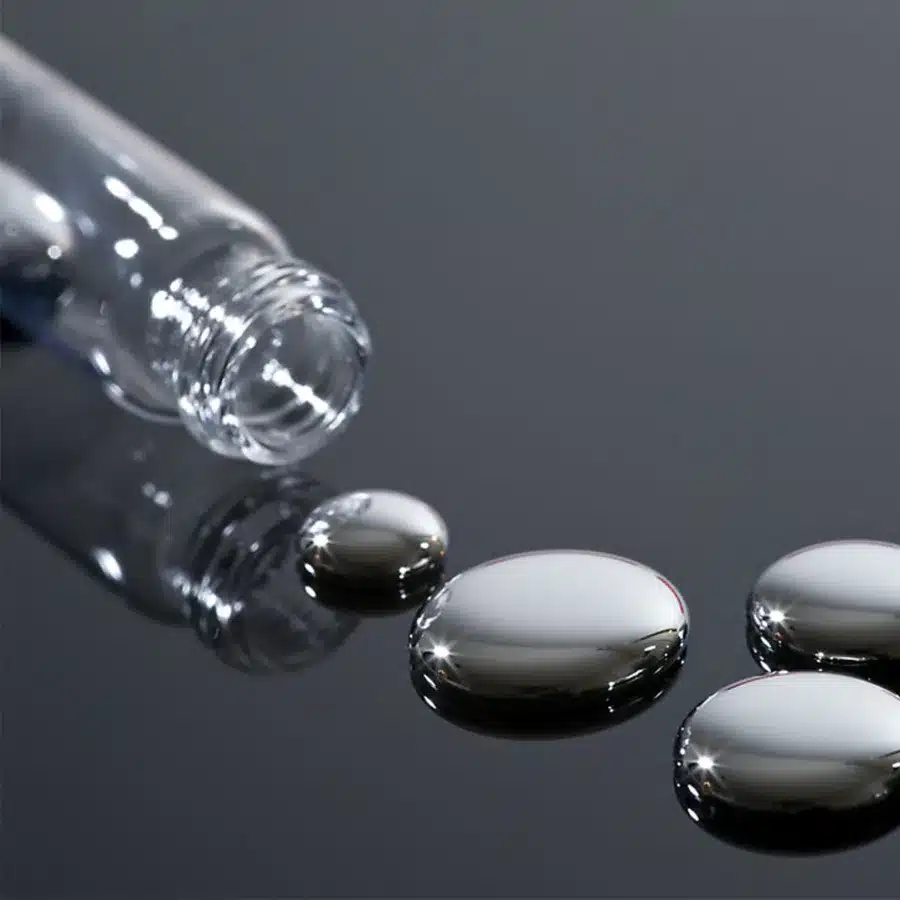
Elemental mercury is a dense, silver-colored liquid metal. When spilled, it can break into many small droplets that roll away from the original spill location and become trapped in floor seams, beneath baseboards, under equipment, within carpeting or in other difficult-to-access areas.
At room temperature, elemental mercury releases vapor into the air. Mercury vapor cannot be seen or smelled. The concentration present during testing can vary with the amount of residual mercury, room temperature, ventilation, air movement, source disturbance and the effectiveness of previous cleanup.
For that reason, finding no visible mercury does not by itself demonstrate that a spill has been fully addressed. A useful assessment may combine inspection, spill-history review, direct-reading measurements and laboratory-based air sampling.
Avoid spreading the contamination
Do Not Use an Ordinary Vacuum, Mop or Broom on Spilled Mercury
New York State Department of Health and EPA guidance warn against ordinary vacuuming or sweeping of elemental mercury spills. These methods can divide mercury into smaller droplets, spread it into a larger area, contaminate the equipment and increase mercury vapor in the air.
Ordinary Vacuum Cleaner
Do not use a household or shop vacuum to collect elemental mercury. The equipment can become contaminated and can increase airborne mercury vapor.
Brooms and Mops
Sweeping or mopping can spread small mercury droplets and make source removal more difficult.
Tracking
Walking through the spill area can move mercury or contaminated dust onto footwear, contents and adjacent rooms.
Specialized mercury-response equipment is different from an ordinary vacuum.
Professional spill-response contractors may use equipment specifically designed for mercury recovery. The public-health warning against vacuuming refers to ordinary household, shop and general-purpose vacuum cleaners.
Different tools answer different questions
Direct-Reading Mercury Surveys vs. NIOSH 6009 Air Sampling
Direct-Reading Mercury Vapor Analyzer
A portable mercury vapor instrument can provide rapid measurements at multiple locations and may be useful for locating residual sources, tracing migration and comparing areas during the inspection.
- Immediate field response
- Useful for spatial source tracing
- Can evaluate cracks, edges and suspect reservoirs
- Results depend on instrument capability and field conditions
NIOSH Method 6009
NIOSH 6009 collects elemental mercury vapor on Hopcalite sorbent media over a defined air volume and uses laboratory analysis to produce a time-integrated concentration for the selected sampling period.
- Laboratory-supported documentation
- Known sample duration and volume
- Useful for selected occupied or occupational locations
- Reporting limit must match the project objective
Source Survey Plus Confirmation
A direct-reading survey can help identify where additional investigation is needed, while a laboratory sample can document selected conditions over a longer period.
- Real-time source localization
- Targeted laboratory sample placement
- Better documentation of room conditions
- More defensible interpretation than a single isolated reading
Recognized elemental mercury air method
How NIOSH Method 6009 Works
NIOSH Method 6009 is a workplace air-sampling method for elemental mercury. The method uses a solid sorbent tube containing Hopcalite and a calibrated low-flow sampling pump.
The published method specifies a flow rate of 0.15 to 0.25 liters per minute and a total sample-volume range of 2 to 100 liters. The collected elemental mercury is measured by cold-vapor atomic absorption.
Because the method was developed for occupational air monitoring, residential, school or post-spill projects require additional planning. The laboratory reporting limit, sample duration, expected concentration and intended comparison criterion should be established before collecting the sample.
A sampling protocol may also include field blanks, documentation of temperature and ventilation conditions, and multiple sample locations selected according to the spill history.
Rapid source-location information
What a Direct-Reading Mercury Vapor Survey Adds
A low-level mercury vapor analyzer can provide many measurements during the site visit rather than one integrated result for one location. This makes direct-reading instruments particularly useful for source tracing and understanding how concentrations vary across the affected area.
Source Location
Measurements can be taken near floor cracks, baseboards, carpeting, equipment, furnishings and other areas where small mercury droplets may remain.
Spatial Mapping
Multiple readings can help compare the original spill area, adjacent spaces, suspected pathways and background locations.
Post-Cleanup Screening
Direct readings can help identify remaining localized sources that might be missed by a small number of fixed-location laboratory samples.
A direct-reading result and a laboratory result are not automatically interchangeable.
Instruments differ in detection capability, response characteristics and calibration requirements. A direct-reading survey is especially useful for locating patterns, while time-integrated sampling can provide a laboratory-supported concentration for selected conditions.
Room conditions can change the result
Temperature and Ventilation Matter During Mercury Vapor Testing
Mercury vapor concentration can change when room temperature or ventilation changes. Heating, cooling, open windows, exhaust fans, HVAC operation and temporary ventilation after cleanup can affect what is measured during the visit.
For post-cleanup verification, the sampling conditions should be documented so the result is not interpreted without knowing whether the room was heavily ventilated immediately before testing or whether normal building conditions had been restored.
The appropriate test conditions depend on the purpose of the assessment. Source tracing, occupational monitoring and reoccupancy support may each require a different sampling strategy.
Verification after corrective work
Post-Cleanup Mercury Vapor Testing
Post-cleanup testing can help document selected air conditions after visible mercury has been removed, contaminated materials have been addressed and the spill area has undergone appropriate cleanup.
Confirm Source Removal
Air testing should not be used as a substitute for appropriate source removal. Residual droplets and contaminated porous materials should be addressed before relying on verification measurements.
Evaluate Relevant Locations
Depending on the spill, testing may include the original source area, breathing-zone locations, adjacent rooms, likely migration pathways and selected comparison areas.
Interpret Under Documented Conditions
Results should be reviewed with temperature, ventilation, elapsed time, cleanup actions, analytical sensitivity and the purpose of the verification.
A single non-detect does not prove that all residual mercury is absent.
A non-detect means the selected sample did not contain mercury above the applicable reporting or detection capability under the conditions tested. It does not establish that every crack, room, object or concealed location is free of mercury.
Choose criteria for the actual objective
Occupational Limits and Residential Spill Guidance Are Not the Same Thing
NIOSH and OSHA publish occupational exposure criteria for workers. Those values are designed for occupational exposure assessment and should not automatically be used as residential reoccupancy or public-health spill clearance values.
Residential and institutional spill investigations may instead rely on public-health guidance, agency recommendations, project-specific criteria and professional judgment. The appropriate comparison depends on the population, building use, sample duration and objective of the assessment.
A Mercury Air Result May Help Document
- The concentration measured at a selected location
- Differences among rooms or source areas
- Conditions after cleanup or source removal
- Occupational exposure when sampling is designed for that purpose
- Whether additional source tracing or cleanup review may be warranted
A Mercury Air Result Does Not Automatically Establish
- That every part of the building is free of residual mercury
- The condition of unsampled cracks, contents or concealed spaces
- A person's exact historical exposure dose
- Whether a medical condition was caused by the spill
- That an occupational limit is an appropriate residential clearance level
Common testing scenarios
When Mercury Vapor Testing May Be Useful
Broken Mercury Thermometer
Testing may help evaluate the source room and nearby areas after spill cleanup, particularly when droplets entered cracks or porous materials.
Mercury Was Vacuumed
An ordinary vacuum can spread contamination and become a continuing source. The room, vacuum and areas through which it was moved may require review.
Historical or Unknown Spill
Mercury beads discovered after an unknown period may warrant source tracing and evaluation of nearby materials and occupied spaces.
Laboratory or Workplace Exposure
Occupational monitoring may include personal breathing-zone or area sampling when workplace exposure is the question.
Post-Cleanup Verification
Testing can provide independent documentation after cleanup, contaminated material removal or other corrective work.
Property or Legal Documentation
Owners, schools, property managers, attorneys, insurers or employers may require an independent record of testing methods and findings.
Related Angstrom resources
Mercury Vapor and Indoor Air Testing
Independent spill assessment, NIOSH 6009 sampling, direct-reading surveys, post-cleanup verification and written industrial hygiene reporting.
View mercury testing service Indoor Air Quality TestingBuilding-related odor, particle, ventilation and chemical-air-quality investigations.
View indoor air quality testing Formaldehyde & VOC TestingLaboratory-supported air testing for chemical vapors and persistent indoor odors.
View chemical air testingPrimary public-health and technical sources
NIOSH, EPA and New York State Mercury Resources
Published sampling and analytical method for elemental mercury vapor using Hopcalite sorbent media and cold-vapor atomic absorption.
Open NIOSH Method 6009 CDC / NIOSH NIOSH Pocket Guide — MercuryOccupational information concerning mercury properties, exposure routes, exposure limits, measurement methods and target organs.
Open NIOSH Pocket Guide EPA What to Do if You Have a Mercury SpillEPA guidance for mercury-containing product spills, thermometer spills and larger elemental-mercury incidents.
Open EPA guidance NYSDOH Mercury Information and Spill ResourcesNew York State public-health information concerning elemental mercury, spill cleanup, measurement and exposure prevention.
Open NYSDOH mercury resourcesMercury vapor testing questions
Frequently Asked Questions
What is mercury vapor testing?
Mercury vapor testing evaluates elemental mercury present in air at selected locations and under defined conditions. A project may use direct-reading measurements, time-integrated laboratory samples or both.
Why should I not use a household vacuum on spilled mercury?
Public-health agencies warn that an ordinary vacuum can increase mercury vapor, spread small droplets and contaminate the vacuum itself. Specialized mercury-recovery equipment used by trained responders is different.
What is NIOSH Method 6009?
NIOSH 6009 is an elemental-mercury air method using Hopcalite sorbent media collected with a low-flow pump and analyzed by cold-vapor atomic absorption.
What is the difference between NIOSH 6009 and a mercury vapor analyzer?
NIOSH 6009 produces a time-integrated laboratory result for a defined sampling period. A direct-reading analyzer produces rapid field measurements that can be useful for locating sources and evaluating spatial patterns.
Does temperature affect mercury vapor testing?
Yes. Mercury vapor concentrations can vary with temperature, ventilation, HVAC operation, air movement and source disturbance. Those conditions should be documented during testing.
Can one non-detect prove all mercury is gone?
No. A non-detect applies to the selected sample, reporting capability and conditions tested. It does not prove that every crack, object, room or concealed area is free of residual mercury.
Can OSHA or NIOSH occupational limits be used as a residential clearance standard?
Occupational exposure limits are designed for workplace exposure assessment. They should not automatically be treated as residential reoccupancy or public-health spill clearance values.
Can mercury vapor testing diagnose illness?
No. Environmental testing documents selected building and air conditions. It does not diagnose illness or establish individual medical causation. Health concerns should be addressed with an appropriate health care professional or public-health agency.
Need Mercury Vapor Testing After a Spill?
Angstrom provides independent mercury vapor assessment, direct-reading surveys when included in the scope, NIOSH 6009 air sampling, post-cleanup verification and written environmental reporting.