PAGE LAST UPDATED:

Crystalline Silica Air Monitoring, Dust Testing and Industrial Hygiene Consulting

Crystalline Silica Dust Testing and Air Monitoring in NYC, Long Island, Westchester, New Jersey & Connecticut

Independent respirable crystalline silica air testing, employee exposure monitoring, area and perimeter sampling, settled-dust testing, construction-dust migration assessments, baseline monitoring, and written industrial hygiene reports.

  • NIOSH Method 7500 laboratory analysis
  • Personal and area air monitoring
  • Independent settled-dust assessment
  • CIH and QEP professional oversight
Industrial hygienist fitting a worker with personal respirable crystalline silica air-monitoring equipment
Occupational exposure assessment generally requires personal breathing-zone sampling that represents the worker, task, controls, and work period being evaluated.
CIH & QEP Oversight Professional technical review
NIOSH Method 7500 X-ray diffraction analysis
Industrial Hygiene Sampling Personal, area and task monitoring
Independent Consulting No cleanup-contractor conflict

Independent silica and construction-dust assessment

Silica Testing for Worker Exposure, Dust Migration and Building Complaints

Angstrom Testing Services LLC provides respirable crystalline silica air monitoring, employee exposure assessment, area and perimeter sampling, settled-dust testing, baseline monitoring, construction-dust migration assessment, industrial hygiene consulting, and written reporting for residential, commercial, institutional, construction, transit, infrastructure, manufacturing, and public-sector projects.

Silica concerns may involve concrete cutting, coring, drilling, grinding, chipping, jackhammering, demolition, façade work, brick and block disturbance, mortar removal, repointing, stone fabrication, countertop cutting, tile work, abrasive blasting, tunneling, road work, masonry, cementitious products, and other silica-containing materials.

The correct sampling approach depends on the question being asked. Personal breathing-zone monitoring is used to evaluate employee exposure. Area and perimeter sampling can document selected locations outside the worker’s breathing zone. Settled-dust testing can help characterize dust deposited on selected surfaces. These sample types are related, but they are not interchangeable.

Angstrom provides independent inspection, testing, sampling, laboratory coordination, consulting, and reporting. We do not perform construction, demolition, concrete cutting, dust cleanup, remediation, abatement, or restoration contracting.

Common project conditions

When Crystalline Silica Testing May Be Useful

Concrete Cutting and Coring

Wall saws, slab saws, handheld saws, core drills, floor grinders, scarifiers, chipping tools, and jackhammers can generate respirable silica-containing dust.

Masonry and Façade Work

Brick cutting, block work, mortar removal, repointing, tuckpointing, façade restoration, stone work, and demolition may require exposure or area monitoring.

Engineered-Stone Countertops

Cutting, grinding, polishing, finishing, installation, and repair of quartz-rich engineered stone can generate high concentrations of respirable crystalline silica.

Employee Exposure Monitoring

Personal breathing-zone samples may be used to evaluate representative workers, tasks, shifts, tools, materials, controls, and respiratory-protection decisions.

Dust Migration Into Occupied Areas

Construction dust may enter apartments, offices, corridors, stairwells, neighboring units, common areas, HVAC systems, or other spaces outside the work zone.

Baseline and Perimeter Monitoring

Pre-work, upwind, background, perimeter, adjacent-area, or continuous project monitoring may support transit, infrastructure, façade, demolition, and public projects.

Post-Work Settled Dust

Selected surface samples may help document whether crystalline silica is present in dust deposited after cutting, demolition, masonry work, or uncontrolled migration.

Legal, Contractual or Agency Documentation

Owners, employers, contractors, unions, attorneys, insurers, agencies, and facility managers may need independent sampling methods, laboratory results, and written interpretation.

Air, dust and industrial hygiene services

Types of Silica Testing We Perform

Sampling is selected for the employee, task, location, project phase, material, particle-size fraction, regulatory objective, analytical sensitivity, and intended use.

Personal Breathing-Zone Monitoring

A respirable size-selective sampler is positioned in the worker’s breathing zone to evaluate exposure during representative tasks or work periods.

Full-Shift Exposure Monitoring

Sampling may be designed to represent an eight-hour time-weighted average or another work period appropriate to the exposure-assessment objective.

Task-Based Monitoring

Shorter-duration samples may document selected high-dust activities, tool use, material disturbance, control performance, or task-specific exposure patterns.

Area Air Monitoring

Fixed-location samples may be collected inside or outside work zones, near occupied areas, at boundaries, or along suspected migration pathways.

Perimeter and Adjacent-Area Monitoring

Monitoring may document selected locations around containment, building perimeters, neighboring spaces, public areas, or sensitive receptors.

Baseline Monitoring

Pre-construction or pre-disturbance samples may characterize selected background conditions before transit, utility, façade, demolition, or infrastructure work.

Settled Silica Dust Testing

Dust samples may be collected from documented surface areas to identify or quantify crystalline silica in selected deposited dust.

Construction-Dust Migration Assessment

Inspection, pathway review, containment observations, particle screening, area sampling, and settled-dust testing may be combined.

Dust-Control Evaluation

Sampling may support review of local exhaust, vacuum shrouds, wet methods, isolation, housekeeping, HEPA filtration, and work-practice controls.

NIOSH Method 7500 Analysis

Respirable crystalline silica samples may be analyzed by X-ray diffraction for quartz, cristobalite, and tridymite using NIOSH Method 7500 or another suitable method.

Real-Time Particle Monitoring

Direct-reading particle instruments may help document timing and dust patterns, but they do not identify the crystalline-silica content of the particles.

Industrial Hygiene Reports

Reports may include tasks, workers, controls, flow rates, durations, sample volumes, laboratory results, interpretation, limitations, and recommended next steps.

Quartz, cristobalite and tridymite

What Is Respirable Crystalline Silica?

Crystalline silica is a mineral constituent of many natural and manufactured materials. Quartz is the most common form. Cristobalite and tridymite are other crystalline forms that may be relevant in selected industrial or high-temperature processes.

Concrete, mortar, brick, block, stone, sand, tile, grout, cementitious products, asphalt-containing aggregate, engineered stone, and other materials may contain crystalline silica. The amount varies by material and source.

“Respirable” describes the particle-size fraction capable of penetrating into the gas-exchange region of the lungs. A respirable sampler is designed to collect that size-selective fraction. It does not collect or represent all visible dust in the air.

Cutting, grinding, drilling, crushing, chipping, polishing, demolition, sweeping, abrasive blasting, and other disturbance can create very fine airborne particles. Dust may remain airborne, settle onto surfaces, migrate through openings, or be transported on clothing, tools, equipment, and debris.

Total or Inhalable Dust A broad particle fraction. It may document overall airborne particulate but does not by itself determine respirable crystalline silica concentration.
Respirable Dust The size-selected fraction capable of reaching deep lung regions. It may contain silica and many other mineral or non-mineral particles.
Respirable Crystalline Silica Quartz, cristobalite, or tridymite measured within the respirable particulate fraction. This is the analyte addressed by OSHA’s silica standards.
Settled Dust Dust deposited on surfaces over a period of time. It is not an air concentration and does not directly measure a worker’s inhalation exposure.

Method planning and analytical sensitivity

How Respirable Silica Air Sampling Is Performed

Define the Worker, Task or Monitoring Location

We review the material, tool, activity, shift, work zone, engineering controls, respirator use, weather, ventilation, containment, and reason for sampling.

Select a Respirable Size-Selective Sampler

A cyclone or other accepted respirable sampler and suitable filter media are selected in coordination with the laboratory and applicable method.

Calibrate the Sampling Pump

Pumps are calibrated using a representative sampler assembly at the flow rate required for the selected device, method, and particle-size convention.

Collect the Sample During Representative Conditions

Personal samples are positioned in the breathing zone. Area samples are located according to the migration, perimeter, background, or project-monitoring objective.

Document the Work and Controls

Task duration, tools, materials, water use, local exhaust, vacuum systems, respirators, housekeeping, weather, production rate, and interruptions may be recorded.

Analyze and Interpret the Results

Laboratory results are reviewed with sample volume, reporting limit, duration, worker and task representation, controls, blanks, and the applicable comparison criteria.

Choosing the correct sample type

Personal Exposure, Area Air and Settled Dust Answer Different Questions

Worker Exposure

Personal Breathing-Zone Sample

The sampler is worn by the worker near the nose and mouth. It is intended to represent the employee’s inhalation exposure during the monitored work period.

  • Used for exposure assessment
  • Documents represented tasks and controls
  • Can support OSHA comparison when properly designed
  • Does not characterize every worker or shift automatically
Selected Location

Area or Perimeter Air Sample

The sampler remains at a fixed location. It can document conditions near a work zone, occupied space, perimeter, containment boundary, or suspected migration pathway.

  • Useful for area and migration questions
  • May support baseline or project monitoring
  • Does not substitute for personal exposure monitoring
  • Strongly influenced by sampler location and timing
Deposited Material

Settled-Dust Sample

Dust is collected from a documented surface or area. The result may identify or quantify crystalline silica within the sampled deposited dust.

  • Useful for dust migration and source patterns
  • May reflect deposition over a longer period
  • Not an airborne concentration
  • Does not establish a worker’s exposure dose

Dust generation, sampling and migration

Silica Assessment Must Be Connected to the Work Activity

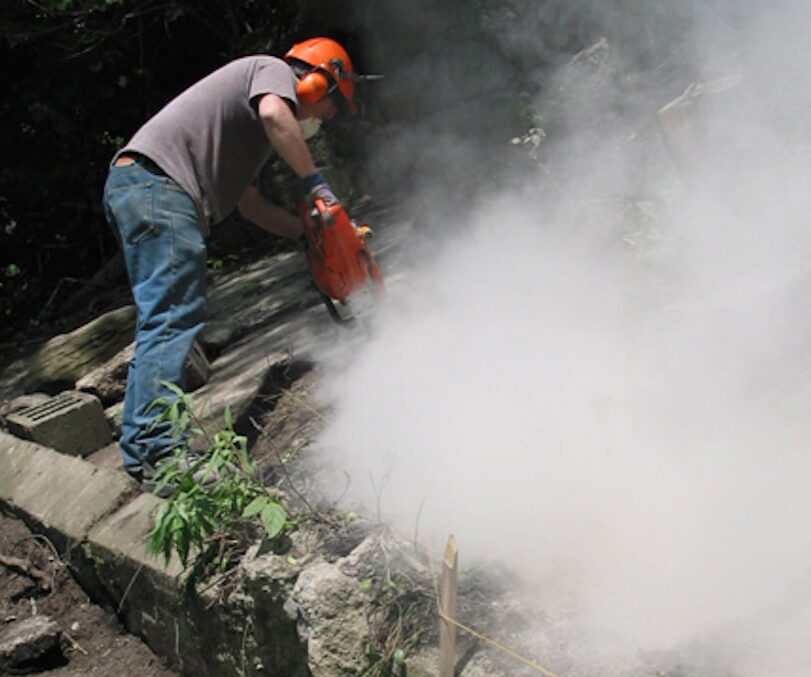
Worker cutting concrete and generating a large visible cloud of construction dust
Cutting, grinding and demolition Visible dust indicates uncontrolled particulate release, but laboratory analysis is needed to determine the respirable crystalline silica concentration.
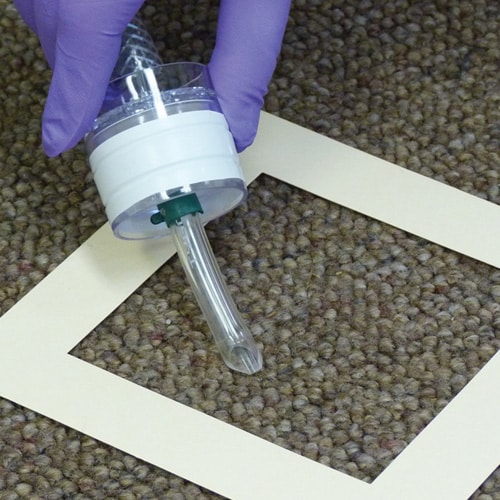
Environmental dust sample collected from a measured surface area
Documented settled-dust sampling Surface type, sampled area, location, cleaning history, work history, and possible sources should be recorded for defensible interpretation.
Construction worker sweeping a large amount of airborne dust at an outdoor work site
Housekeeping and secondary exposure Dry sweeping, compressed air, contaminated clothing, debris handling, and tracked dust can create secondary exposure and migration pathways.

Residential and adjacent-space investigations

Construction-Dust Migration Into Apartments, Offices and Common Areas

Dust migration may occur when cutting, grinding, drilling, demolition, or debris handling is performed without adequate isolation, local exhaust, wet methods, negative pressure, housekeeping, or protection of occupied areas.

Common pathways include doors, corridors, stairwells, elevator shafts, plumbing and electrical penetrations, risers, pipe chases, floor openings, ceiling voids, façade openings, shared walls, HVAC returns, fan-coil units, ductwork, and unsealed containment.

An assessment may include complaint and work-history review, photographs, visible-dust observations, containment review, pressure relationships, real-time particle screening, area air sampling, settled-dust sampling, HVAC inspection, and appropriate comparison areas.

OSHA’s occupational exposure limits should not be presented as residential clearance standards. Residential, public-adjacent, or property-damage evaluations require site-specific interpretation based on the sample type, work history, dust distribution, sources, background, cleaning, and purpose of the assessment.

Deposited construction dust

Settled Silica Dust Testing and Interpretation

What a Settled-Dust Result Can Show

Laboratory analysis can identify or quantify crystalline silica in the specific dust collected from a documented surface. Multiple locations can help evaluate source-to-pathway patterns, affected rooms, adjacent areas, or cleaning effectiveness.

The result may support documentation that silica-containing dust was present in a sampled area, but it should be considered with other dust constituents and field observations.

What It Does Not Show

Settled-dust testing does not directly measure the airborne concentration during the original work, the worker’s breathing-zone exposure, the duration of exposure, or the dose inhaled by an occupant.

A non-detect on one surface does not prove that every room, content, carpet, HVAC component, concealed area, or previously cleaned location is free of silica-containing dust.

No Universal Residential Clearance Level

There is no generally applicable federal health-based clearance standard for crystalline silica mass in settled dust in a private residence. Results should not be labeled as passing or failing a universal residential silica-dust limit.

Interpretation should address the source, material, work activity, spatial pattern, comparison areas, sample area, laboratory method, cleaning history, and project objective.

Cleaning and Follow-Up

Corrective work may involve source control, isolation, HEPA-filtered vacuuming, damp wiping or wet cleaning, appropriate handling of porous materials, HVAC review, and prevention of cross-contamination.

The cleaning protocol should be tailored to the dust quantity, affected materials, property use, contents, access, and other contaminants that may also be present.

Countertop fabrication and installation

Silica Exposure During Engineered-Stone and Quartz Countertop Work

Engineered-stone products can contain a high proportion of crystalline silica. Cutting, grinding, polishing, edge finishing, sink cutouts, drilling, dry fabrication, on-site modification, installation, cleanup, and waste handling can generate respirable dust.

Exposure assessment should consider shop and field work, dry versus wet methods, local exhaust, tool shrouds, production rate, worker position, secondary employees, housekeeping, compressed air, contaminated clothing, enclosed vehicles, and residual dust.

Personal breathing-zone sampling is generally needed to evaluate employee exposure. Area air and settled-dust samples may additionally address bystander, adjacent-area, shop, residential, or post-work contamination questions.

Read the current NIOSH countertop-worker guidance

Occupational exposure criteria

OSHA Respirable Crystalline Silica Requirements

Exposure Limit

50 µg/m³ as an 8-Hour TWA

OSHA’s permissible exposure limit for respirable crystalline silica is 50 micrograms per cubic meter of air, calculated as an eight-hour time-weighted average.

Action Level

25 µg/m³ as an 8-Hour TWA

OSHA’s action level is 25 micrograms per cubic meter as an eight-hour TWA. Exposure-assessment and other obligations depend on the applicable standard and conditions.

Construction

29 CFR 1926.1153

Construction employers may follow specified Table 1 controls for covered tasks or use exposure assessment and controls under the alternative exposure-control provisions.

Open the construction standard
General Industry

29 CFR 1910.1053

The general-industry and maritime standard addresses exposure assessment, regulated areas, controls, respiratory protection, medical surveillance, communication, housekeeping, and records.

Open the general-industry standard

Occupational limits require occupationally representative samples.

A short area sample, perimeter sample, residential sample, surface sample, or particle-counter reading should not be compared directly with an eight-hour employee exposure limit unless the sampling design and calculation legitimately represent the required occupational exposure metric.

Sampling and reporting process

From Project Review to Written Silica Findings

Review the Project

We review the worker, task, material, complaint, work area, controls, property use, project phase, regulatory objective, and documentation needs.

Develop the Sampling Plan

Personal, task, area, perimeter, baseline, particle, or settled-dust samples are selected with suitable durations and laboratory sensitivity.

Calibrate and Collect

Pumps are calibrated with representative sampler assemblies and samples are collected during documented work or environmental conditions.

Document Conditions

Tools, materials, controls, work duration, ventilation, containment, dust pathways, housekeeping, weather, and interruptions may be recorded.

Analyze the Samples

Samples are submitted to a qualified laboratory using NIOSH Method 7500 or another analytical method suitable for the project.

Interpret and Report

Results are reviewed with sample representation, volume, task, location, reporting limits, controls, comparison criteria, and stated limitations.

Project documentation

What You May Receive After Silica Testing

Project and Task Summary Property or workplace information, materials, tasks, workers, complaint history, work zones, controls, and the objective of the assessment.
Sampling Plan Personal, task, area, perimeter, baseline, or settled-dust sample locations, durations, media, equipment, and comparison approach.
Field Documentation Pump calibrations, flow rates, sample volumes, tools, materials, controls, work practices, weather, containment, photographs, and observations.
Laboratory Results Quartz, cristobalite, tridymite, reporting limits, sample mass, air concentrations, dust results, blanks, and laboratory comments.
Professional Interpretation Review of results in relation to the represented worker, task, location, sample duration, controls, source, comparisons, and applicable criteria.
Recommended Next Steps Control improvements, additional monitoring, revised work practices, cleaning, isolation, HVAC review, respiratory-protection review, or follow-up assessment.

Important limitations

What Silica Testing Can and Cannot Establish

Air and dust samples represent selected workers, tasks, locations, surfaces, durations, materials, controls, and conditions included in the sampling plan. Results can change with production rate, tool use, weather, ventilation, containment, work practices, housekeeping, worker position, material composition, and sample duration.

A low or non-detect result for one sample does not prove that crystalline silica is absent from every worker exposure, task, shift, room, surface, HVAC component, concealed area, work zone, or condition not represented by the sampling plan.

Area air monitoring does not automatically represent employee exposure. Settled-dust testing is not an airborne concentration. Real-time particle monitoring does not identify quartz, cristobalite, or tridymite without laboratory analysis.

OSHA’s action level and permissible exposure limit are occupational criteria. They should not be described as residential, occupant, environmental, property-damage, or settled-dust clearance standards.

A sample with insufficient air volume, a high laboratory reporting limit, filter overloading, mineral interference, pump interruption, unrepresentative task conditions, or inadequate documentation may not support the intended comparison or conclusion.

Environmental and occupational testing does not diagnose silicosis, lung cancer, chronic obstructive pulmonary disease, kidney disease, or any individual medical condition. Medical concerns should be addressed by an appropriate health care professional.

Official silica standards and technical resources

Government Guidance for Exposure Assessment, Controls and Dust Prevention

These official resources address health effects, construction and general-industry standards, sampling and analysis, engineering controls, countertop work, mining, and New York City construction-dust requirements.

OSHA Crystalline Silica Overview

OSHA information on silica-related disease, construction and general-industry standards, compliance resources, training, and exposure control.

Open OSHA silica resources
OSHA Construction Silica Resources

Construction-standard guidance concerning Table 1, exposure assessment, written control plans, engineering controls, respirators, and housekeeping.

Open construction resources
OSHA General Industry and Maritime

Compliance resources for regulated areas, exposure assessment, controls, medical surveillance, respiratory protection, communication, and records.

Open general-industry resources
CDC / NIOSH NIOSH Crystalline Silica Methods

Official NIOSH method listing for crystalline silica, including Method 7500 by X-ray diffraction and complementary analytical approaches.

Open NIOSH methods
CDC / NIOSH Health Effects of Occupational Exposure

NIOSH review of silicosis, lung cancer, obstructive lung disease, renal effects, autoimmune effects, exposure, and prevention.

Open NIOSH health-effects review
CDC / NIOSH Countertop Worker Exposure

Current worker guidance for engineered-stone and countertop fabrication, installation, controls, respirators, housekeeping, and exposure prevention.

Open countertop guidance
MSHA Mining Silica Final Rule Resources

Mine Safety and Health Administration resources concerning respirable crystalline silica exposure limits, sampling, controls, and respiratory protection.

Open MSHA resources
NYC DEP Construction Dust Control Rules

New York City rules concerning dust-generating operations and controls intended to prevent construction dust from becoming airborne.

Open NYC dust rules

External links are provided for public information. Their inclusion does not imply that any government agency endorses, certifies, or is affiliated with Angstrom Testing Services LLC. Requirements must be confirmed for the specific employer, worker, jurisdiction, contract, material, task, exposure scenario, and current law.

Related environmental testing

Related Services for Construction Dust and Building Hazards

Silica testing FAQs

Frequently Asked Questions

What is respirable crystalline silica?

Respirable crystalline silica consists of quartz, cristobalite, or tridymite contained in airborne particles small enough to penetrate into the gas-exchange region of the lungs. It may be generated when concrete, brick, mortar, stone, tile, engineered stone, or other silica-containing materials are disturbed.

When should silica air monitoring be performed?

Monitoring may be useful during cutting, coring, grinding, drilling, chipping, demolition, repointing, façade work, countertop fabrication, tunnel work, abrasive blasting, or other tasks that can generate respirable silica-containing dust.

Do you provide personal employee exposure monitoring?

Yes. A respirable sampler can be placed in the worker’s breathing zone to evaluate representative exposure during selected tasks, work periods, or shifts. The plan should document materials, controls, tools, respirators, and worker activities.

What is NIOSH Method 7500?

NIOSH Method 7500 is an X-ray diffraction method used to analyze crystalline silica collected on a filter. The laboratory may report quartz, cristobalite, and tridymite, subject to the method, sample loading, interferences, and laboratory capability.

Can a particle counter measure crystalline silica?

No. A particle counter can document particle-number or mass-estimate patterns within selected size channels, but it cannot determine whether the particles contain quartz, cristobalite, or tridymite. Laboratory analysis is required.

Do you provide settled silica dust testing?

Yes. Dust can be collected from selected documented surfaces to evaluate whether crystalline silica is present in deposited dust after construction, demolition, masonry, countertop, façade, or migration events.

Is settled-dust testing the same as exposure monitoring?

No. Settled-dust testing evaluates selected deposited dust. Occupational exposure monitoring uses personal breathing-zone air samples designed to represent the worker’s airborne exposure during the monitored work period.

Can OSHA’s silica limit be used as a residential standard?

No. OSHA’s action level and permissible exposure limit are occupational eight-hour time-weighted-average criteria. They are not residential, occupant, settled-dust, property-damage, or universal environmental clearance standards.

Can one non-detect result prove the building is free of silica dust?

No. A non-detect applies to the selected sample and its reporting limit. It does not prove absence from every room, surface, content, carpet, HVAC component, concealed area, previously cleaned location, task, or time period.

Do you evaluate construction-dust migration?

Yes. A project may include visual inspection, work-history review, containment assessment, pathway evaluation, area air sampling, particle screening, HVAC review, settled-dust testing, comparison areas, and written findings.

Do you perform silica-dust cleanup or construction work?

No. Angstrom provides independent testing, exposure assessment, sampling, industrial hygiene consulting, laboratory coordination, and reporting. We do not perform construction, demolition, dust cleanup, remediation, or abatement.

Will I receive a written report?

Yes, when included in the agreed scope. Documentation may include project history, workers or locations monitored, sampling methods, calibrations, flow rates, durations, laboratory results, interpretation, limitations, photographs, controls, and recommended next steps.

What areas do you serve?

Angstrom provides silica testing in New York City, Long Island, Westchester, southern Connecticut, eastern New Jersey, and nearby areas. Availability depends on the project type, required equipment, laboratory sensitivity, duration, access, urgency, and reporting needs.

Discuss the work activity or dust concern

Request Independent Silica Testing

Describe the property or workplace, location, material, cutting or demolition activity, workers or areas of concern, dates and duration, dust controls, containment, cleaning, complaint history, and whether you need personal exposure monitoring, area or perimeter air sampling, baseline testing, settled-dust testing, or written project documentation.

google reviews

They were awesome! They really exert the effort to make sure the mold inspection is done correctly. I wanted to test the air on a condo that we were purchasing (because it had a strong damp smell when you walked in). Thanks, Angstrom & Team for helping me in time.
C. Peters

Angstrom tested the water at each of the sinks in our daycare center for lead. They helped us get our license from the New York City Department of Health. They arrived on time and got the job done without any hassles and provided all the paperwork that I needed. Thanks again! Philip Bleeker

Angstrom Testing Services