Mold Remediation
Angstrom Testing Services has been successfully conducting mold remediation work for the past approximately 20 years. In New York State, we are required to follow Article 32 of the NY State Mold Law. Following this law assures that acceptable occupant, premises, and worker safe work practices are utilized and that workers have the necessary training and experience to successfully complete the mold remediation work.
Call Angstrom Testing Services (516) 724-4574 and speak to one of our mold remediation specialists to discuss your mold problem.
Mold Remediation Work Overview
Our Mold Remediation Process
-
Controlled Removal: Impacted finishes are removed under strictly controlled conditions to prevent the spread of spores.
-
Surface Treatment: Contaminated materials that remain in place (such as framing) are thoroughly cleaned using EPA-registered biocides or mild abrasive blasting.
-
Encapsulation: Where necessary, treated surfaces are sealed with a clear, antimicrobial coating.
-
Advanced Cleaning: We utilize HEPA vacuums and disinfectant wiping throughout the work and surrounding areas to ensure all settled spores are removed.
-
Air Filtration: We employ air filtration devices under neutral pressure to effectively remove airborne spores from the environment.
-
Post-Remediation Verification: We determine clearance through a combination of rigorous visual inspections and professional air quality testing for mold spores.
-
Commitment to Results: If initial testing or visual assessment does not meet clearance standards, we perform additional cleaning and removal until the area is successfully remediated.


Mold Prevention Strategies
- Humidity should be maintained less than 60% to prevent mold growth from occurring on furniture and furnishings, especially in basements.
- Chilled water pipes should be insulated to prevent condensate formation on pipes in the summer.
- The earth near the foundation of the house should be at the highest elevation and then pitched downwards to help water drain away from the foundation.
- Air handlers in attic should be inspected during periods of high usage. Condensate drip pans should be pitched to drain towards the drain pipes, and drain pipes should be inspected for clogs.
Mold Removal Safe Work Practices
Mold Growth & Prevention
-
Act Fast: Water damage should be addressed immediately to stop hazardous mycotoxins from forming within weeks.
-
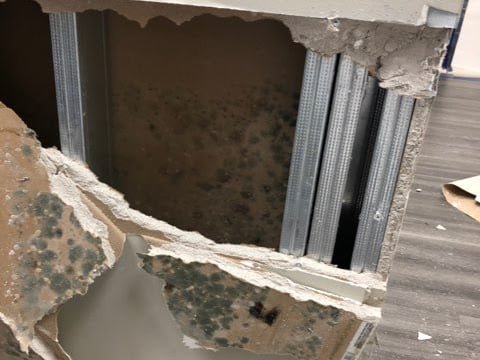
Common Fuel: Mold feeds on organic materials found in paint and the paper backing of drywall (sheetrock).
-
Toxic Risks: Certain fungi, like Stachybotrys, thrive on building materials and can quickly become dominant if moisture remains.
Our Safety Standards
-
Containment: We use heavy-duty plastic barriers to isolate contaminated work zones from the rest of the building.
-
Air Filtration: High-powered “Negative Air” machines capture spores and exhaust filtered air outdoors to prevent cross-contamination.
-
Protective Gear: Our team always wears specialized HEPA respirators, gloves, and eye protection for maximum safety.
Mold Clearance Criteria
After mold remediation work has been completed, and prior to any rebuild work being performed, a post-mold remediation clearance inspection and airborne mold testing should be performed to evaluate whether the remediation work was properly performed and the air quality with regard to airborne mold levels is in the normal and acceptable range and safe for reoccupancy. The following guidelines apply:
- No discernible musty odors
- No significant levels of measurable moisture (below 17% on wood surfaces)
- No significant levels of visible settled dust
- No significant visible water damage
- No significant visible mold growth
- Levels of airborne Penicillium/Aspergillus should be less than 500 structures/m3 higher than outdoors, and levels of airborne Stachybotrys should be less than 50 structures/m3 higher than outdoors.